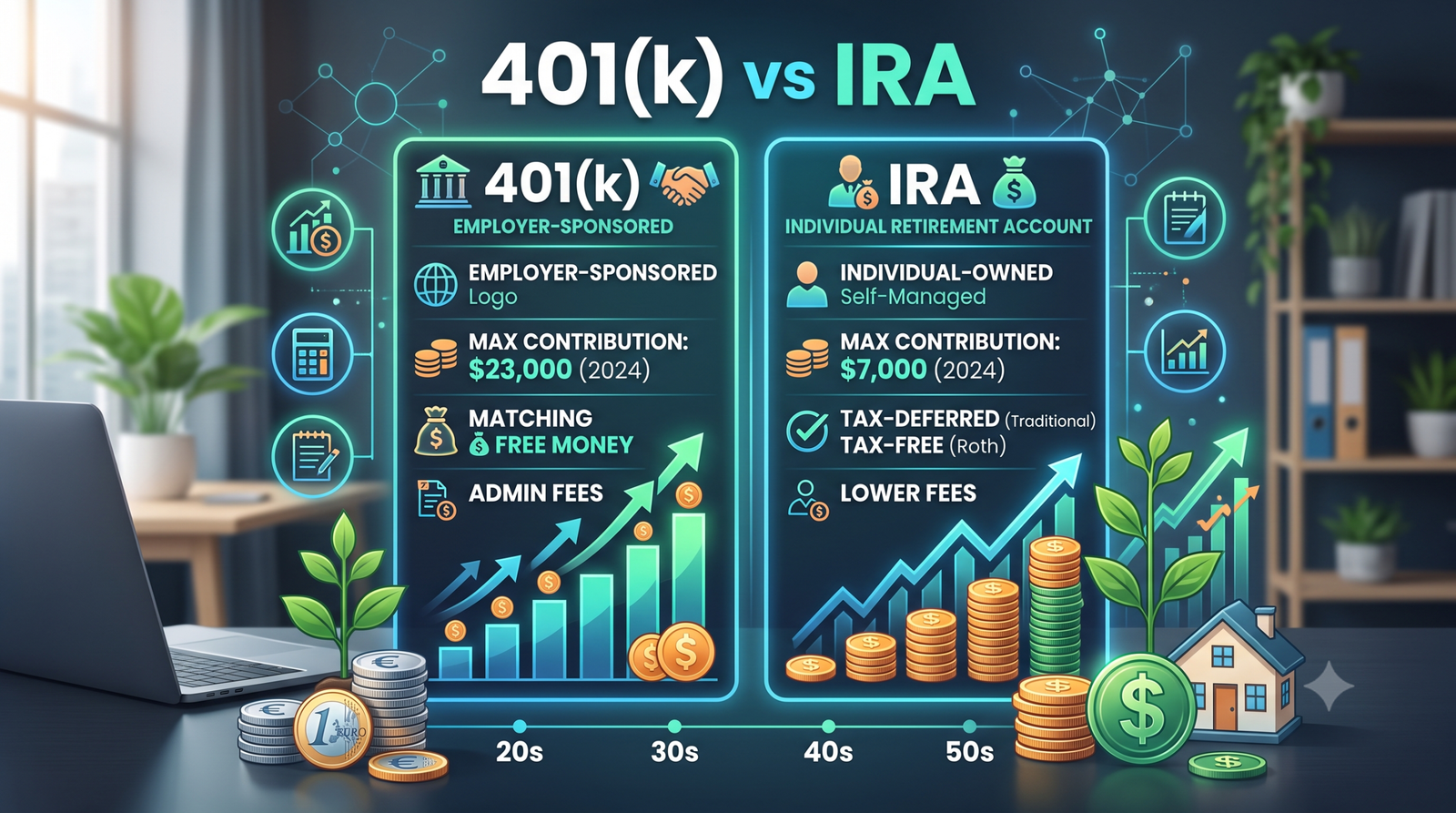
Somewhere between your first paycheck and your first “you should really be saving for retirement” conversation, two acronyms tend to show up: 401(k) and IRA. They both help you save for the future, they both come with tax perks, and they’re both frequently mentioned in the same breath — which is exactly why so many people mix them up.
Here’s the thing: 401(k) vs. IRA isn’t really an either-or question for most savers. It’s more like understanding two different tools in the same toolbox, each suited to a different job. By the end of this article, you’ll know how each account works, where they overlap, where they diverge, and how to think about using both to build a more resilient retirement plan.
What Is a 401(k)?
A 401(k) is an employer-sponsored retirement plan. If your job offers one, you can choose to have a percentage of each paycheck automatically diverted into an investment account before you ever see the money. That “automatic” part is one of the biggest reasons 401(k)s work so well for people — saving happens without requiring willpower every single month.
The Employer Match: Free Money You Shouldn’t Ignore
Many companies sweeten the deal with a matching contribution. A common structure might involve the employer matching a portion of what you contribute, up to a certain percentage of your salary. The exact formula varies widely from company to company, so it’s worth checking your own plan documents rather than assuming a specific number.
If your employer offers a match, contributing at least enough to capture the full match is generally considered one of the more straightforward wins in personal finance — it’s effectively part of your compensation package. Leaving it on the table is a bit like skipping a raise you already qualified for.
Contribution Limits and Tax Treatment
401(k) plans typically allow much higher annual contribution limits than IRAs, though the exact figures change periodically and should be verified against current IRS guidance before you rely on them for planning purposes. Traditional 401(k) contributions are usually made with pre-tax dollars, which lowers your taxable income now, while withdrawals in retirement are taxed as ordinary income. Many employers also offer a Roth 401(k) option, where you contribute after-tax dollars and withdrawals are typically tax-free in retirement, assuming certain conditions are met.
What Is an IRA?
An IRA, or Individual Retirement Account, isn’t tied to an employer at all. You open one yourself through a brokerage, bank, or robo-advisor, which means the investment choices are entirely up to you — a meaningful difference from many 401(k) plans that limit you to a preset menu of funds.
Traditional IRA vs. Roth IRA
There are two main flavors. A Traditional IRA generally allows tax-deductible contributions, with taxes paid upon withdrawal in retirement. A Roth IRA works in reverse: contributions are made after tax, but qualified withdrawals in retirement are generally tax-free. Which one makes sense often depends on whether you expect your tax rate to be higher or lower in retirement compared to today — a question that’s genuinely hard to answer with certainty, which is why many financial professionals suggest diversifying between both tax treatments when possible.
Contribution Limits and Income Restrictions
IRAs come with lower annual contribution limits than 401(k)s, and Roth IRAs in particular have income eligibility limits that can reduce or eliminate your ability to contribute directly once your earnings pass certain thresholds. These limits and thresholds are adjusted periodically, so check current figures from the IRS or a qualified tax professional rather than relying on older numbers you may have seen elsewhere.
401(k) vs. IRA: The Core Differences
Laid out side by side, a few patterns emerge.
Access: A 401(k) requires an employer that offers one. An IRA is open to almost anyone with earned income, regardless of where — or whether — they work.
Investment choices: 401(k) plans usually offer a limited menu curated by the plan administrator. IRAs typically open the door to a much broader universe of stocks, bonds, ETFs, and mutual funds.
Contribution limits: 401(k)s generally allow significantly higher annual contributions than IRAs.
Employer match: Only 401(k)s (and similar employer-sponsored plans) offer the possibility of matching contributions.
Fees: 401(k) plans sometimes carry higher administrative fees baked into the fund options, while IRAs — especially through low-cost brokerages — can sometimes offer more competitively priced investment options. This varies plan by plan, though, so it’s worth comparing your specific options.
Early withdrawal rules: Both accounts generally penalize withdrawals before retirement age, though the exact rules, exceptions, and penalty amounts differ and are worth reviewing carefully before assuming either account offers easy access to your money.
Can You Have Both?
Yes, and for many people, that’s exactly the point. A common approach looks something like this: contribute enough to your 401(k) to get the full employer match, then direct additional retirement savings into an IRA for broader investment flexibility, then return to the 401(k) if you still have more to save and have room under the contribution limits. This isn’t a universal rule — your ideal order depends on your tax situation, the quality of your 401(k) plan’s investment options, and your income level — but it’s a reasonable starting framework for a lot of savers.
Practical Tips / Key Takeaways
- Capture any employer 401(k) match before prioritizing other retirement accounts — it’s compensation you’ve already earned.
- Use an IRA if you want more control over your specific investment choices.
- Consider a mix of Traditional and Roth accounts to diversify your future tax exposure.
- Review current contribution limits and income thresholds annually, since they typically change.
- Don’t assume your plan’s default investment fund is the best fit — take a look at what’s actually available.
- If your income or tax situation is complex, a conversation with a tax professional or financial advisor can help clarify the right approach for your circumstances.
Conclusion
The 401(k) vs. IRA debate isn’t really about picking a winner — it’s about understanding what each account does well. A 401(k) offers convenience, higher contribution limits, and potentially free money through an employer match. An IRA offers flexibility, broader investment options, and independence from any single employer. Used together, thoughtfully and consistently, they can complement each other and give you a retirement strategy that’s both well-funded and well-diversified. The specifics — limits, tax rules, income thresholds — shift over time, so treat this as a foundation for understanding the landscape, and verify current numbers before making decisions that affect your long-term savings.
This article is for general educational purposes only and does not constitute personalized financial or tax advice. Contribution limits, income thresholds, and tax rules change periodically — consult the IRS or a qualified financial professional for current figures and guidance specific to your situation.